
ARK: Survival Ascended Adds Gargantar, Cerberax and More
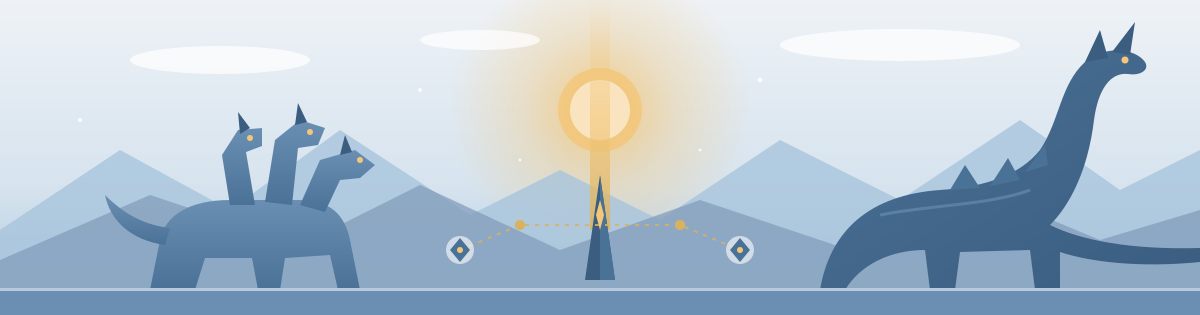
ARK: Survival Ascended just got bigger, in more ways than one.
This latest round of updates isn't one patch. It's three, spread across the base game and two separate DLCs. Each one brings a creature to the island. One is a dragon with a bottomless appetite. One is a three-headed dog with a familiar silhouette. And one is an existing dinosaur that has finally been given some long-overdue attention.
How much of this you can actually play depends on how deep into ARK you've already gone. The base game update is there for everyone. The other two sit behind the Dragontopia and Fantastic Tames Season 1 DLCs, so only players who own those expansions will meet the new monsters. For the committed, though, that's three new reasons to head back out into the wilds.
Gargantar: A Dragon That Grows by Eating
The headline act belongs to Dragontopia. Its new arrival, Gargantar, is a huge dragon with a simple and slightly unsettling hook: the more creatures it eats, the stronger it gets.
That design is worth pausing on. Most creatures in a survival game are a fixed quantity. You find one, you fight it or tame it, and you know roughly what you're dealing with. A beast that scales with its own feeding habits is a different proposition. It turns the dragon into something closer to a project, an animal whose power depends on what has happened to it, not just what it is.
Gargantar's offense is no more refined than its diet. It attacks with acidic spit and acidic vomit. That isn't exactly majestic fantasy dragon fire, but it's certainly memorable, and it fits a creature defined by what goes into its stomach.
Cerberax: Three Heads, Three Sets of Needs
Over in Fantastic Tames Season 1, the new addition is Cerberax, a three-headed hound. Anyone who knows a little Greek mythology will spot the inspiration immediately. Cerberus guarded the gates of the underworld, and Cerberax plainly owes him a debt, even if the name keeps things one step removed.
The interesting part isn't the look, though. It's how you tame the thing. Rather than treating Cerberax as a single animal, players have to manage what each of its three heads wants individually. Satisfy one head and ignore the others, and you're presumably not going to get very far.
Taming has always been the beating heart of ARK, and creature bonding systems keep popping up across multiplayer games. Look at how Soulframe now lets players allocate their wolfpup's stats. Cerberax takes a different route. It isn't about the numbers you assign after the fact. It's about the juggling act you go through to earn the animal in the first place.
Therizinosaurus Gets Some TLC
The third update is the one every ARK player gets, and it doesn't add a new creature at all. The Therizinosaurus, the dinosaur best known for its enormous claws, has received what ARK calls a TLC update. TLC stands for "tender loving care," and the label covers reworks of creatures already in the game.
The changes are practical. The Therizinosaurus now comes with distinct claw styles, and each style signals which resource that particular animal is good at gathering. Instead of guessing, players can read a creature's usefulness straight off its body. On top of that, there's a new bounding leap ability to give it more mobility, along with refreshed visuals.
It's the least flashy of the three updates, but it may well be the one that changes the most day-to-day play, simply because it touches the base game and a creature players already rely on.
All three animals have their own highlight video, so anyone who wants to see Gargantar's eating habits, Cerberax's heads or the Therizinosaurus's new leap in action can check them out ahead of logging in.
Our Take
The split here says a lot about how ARK: Survival Ascended is being built. Two of the three creatures sit inside paid DLCs, while the base game gets a rework, not a brand-new animal. That suggests a model where fresh, eye-catching creatures increasingly arrive as part of add-ons, and the core game is maintained through refinement. For players who own everything, that's great. For those who don't, it's worth watching whether the gap between base-game and DLC content keeps widening.
The mechanics are the more encouraging story. A dragon that scales with its meals and a hound that needs three heads kept happy both push taming beyond "knock it out and feed it." That's the same appetite for deeper creature systems seen elsewhere, from Fallout 76 adding pets to its world to Monster Hunter Wilds promising tougher monster fights. The real test will be how these systems hold up once tribes start competing on live servers.